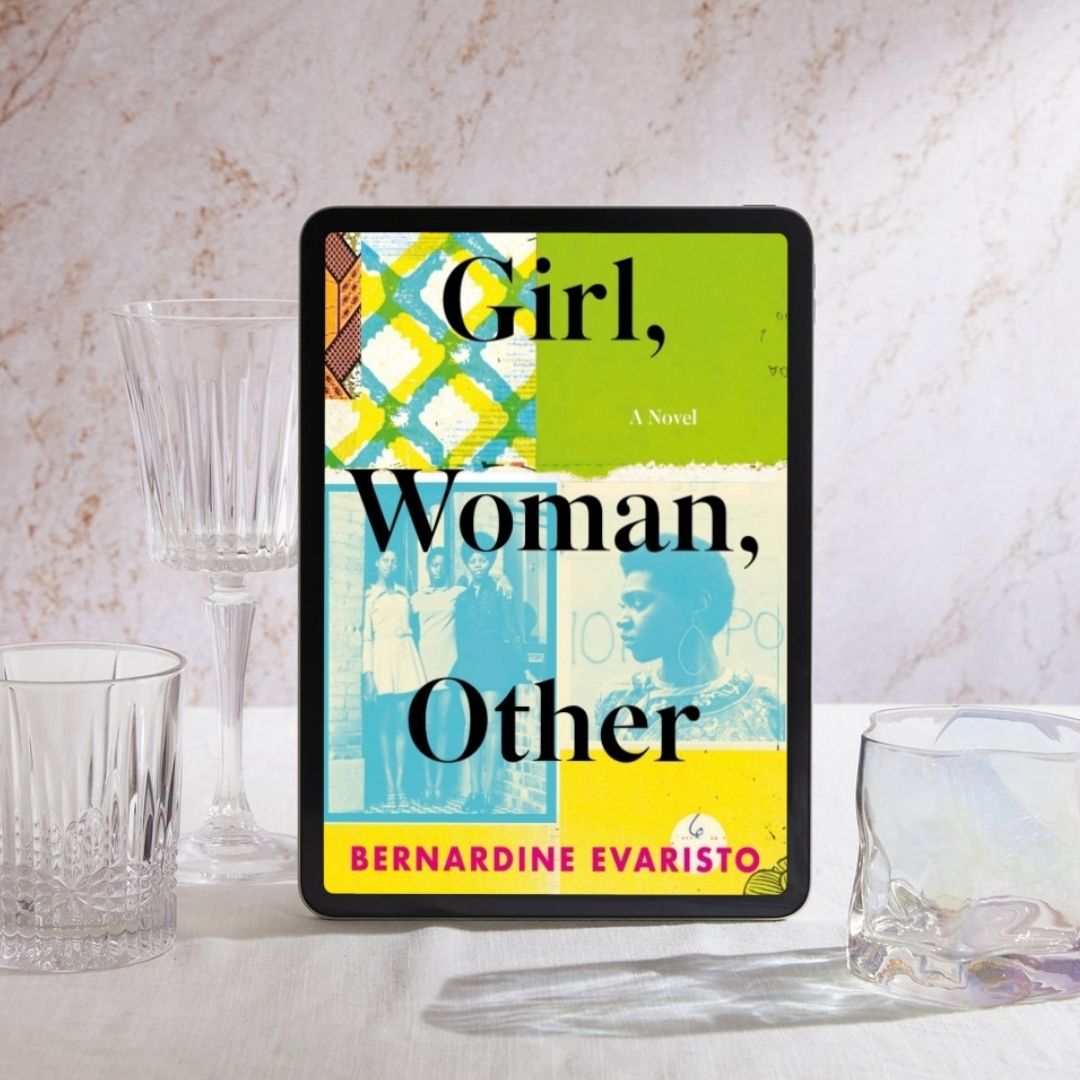
Girl Woman Other by Bernardine Evaristo
Genre: Black British Literary Fiction | Published: 2019
Girl Woman Other is a book I suggested at the beginning of this month as a Black British classic that I think you should all read. I call it a classic despite it only being published in 2019, because I truly believe it will stand the test of time as one of the best works of literary fiction to come out of Black Britain — and Britain more broadly.
It won the Booker Prize in 2019, making Bernardine Evaristo the first Black woman (she is biracial) ever to receive the award. However, her historic achievement was somewhat overshadowed by the decision to make it a joint win with Margaret Atwood’s The Testaments — an unprecedented move that, for many, highlighted the discrimination and racism that Black women and other people of colour face, even in moments of recognition.
I really enjoyed this book, and I can absolutely see why it was both nominated and ultimately won. Bernardine Evaristo captures the Black British experience in an authentic, wide-ranging, and poetic way. I first listened to the book as an audiobook, but while writing this, I went back to read the text itself to get a better sense of Evaristo’s style, structure, and voice.
Before I delve into the book itself, I must say that I feel an immense connection to Bernardine Evaristo. She is half Nigerian, with a paternal grandmother from Abeokuta — the very city I’m from — and she grew up in Woolwich, attending the same after-school drama club I went to as a child. It’s rare to come across someone of her calibre whose life experiences feel so familiar to one’s own. This added a deeper sense of connection for me to this novel, even though I don’t necessarily share much else in common with the women in the story beyond being Black, a woman, and, in some cases, a Nigerian living in London.
Synopsis
Teeming with life and crackling with energy — a love song to modern Britain and black womanhood
Girl Woman Other follows the lives and struggles of twelve very different characters. Mostly women, black and British, they tell the stories of their families, friends and lovers, across the country and through the years.
Thematic Appreciation
At its core, Girl, Woman, Other is a celebration of Black British womanhood in all its forms, its triumphs, struggles, and complexities. It speaks to many experiences of womanhood and Blackness that feel deeply relatable. I appreciated that the story doesn’t shy away from the painful realities that women, especially Black women across generations, have had to face.
The novel explores themes of rape, abuse, sexuality, the immigrant experience, identity, and what it means to be a Black woman in Britain, as far back as the 1900s and in the modern era. The voices throughout feel largely authentic. Often in books of this kind, characters can sound like mouthpieces for the author’s opinions, but here, each perspective feels distinct and true to the person telling it.
That said, I did feel at times that Evaristo’s characters were reduced to representations of popular debates or social identities rather than fully fleshed-out individuals. A phenomenon I have noticed in many stories that serve as social commentary (Americanah). While people like this certainly exist in real life, it occasionally felt as though each identity type had been distilled into a single character, ticking every possible box, rather than allowing a more nuanced, human portrayal.
As readers, we need to feel like characters are real (though we know they aren’t), that they think, feel, and evolve beyond the themes they embody. At various points, some voices came across as more like social media activists or ‘anti-woke contrarians’, delivering set talking points rather than sharing genuine experiences. This, at times, lessened their emotional depth and weakened my connection to them.
This is why some women’s stories resonated with me more than others. Bummi’s and Dominique’s narratives, for instance, felt deeply authentic. Their pain, growth, and resilience were shown rather than told — allowing readers to see clearly how society and their relationships shaped their lives, without the sense of an agenda being imposed.
I will forever applaud the joy of representation and multiplicity in storytelling that Bernadine Evaristo has embodied within this novel.
Character Connections
This is the second book I’ve read recently that uses interconnected characters, with each chapter following a different individual and very few direct callbacks to previous ones. It reminded me of Homegoing, where the connections were largely familial. In Girl Woman Other, however, the relationships are more varied — colleagues, old school friends, mothers, grandmothers, and daughters.
This interconnectedness, however subtle, reinforces the book’s central message about community and shared womanhood. For the first six or so characters, the links are relatively clear and traceable, though less familial as the story progresses. Towards the end, however, the narrative introduces entirely new character lines that only make sense once the connection is revealed in the epilogue. Until that point, these shifts can feel quite random — as I was listening to the audiobook, I even wondered if I’d missed something.
The fragmented nature of the story, for me, mirrors the diversity of women’s lives and experiences. Still, there were many instances, even with clearer connections, when I had to look up who was who. At times, I felt it might have been easier to follow had the characters not been linked at all. Yet I also understand the necessity of their interconnectedness — it reminds us that these women’s stories, though distinct, exist within a shared social and cultural fabric.
That said, the novel can sometimes feel less like a continuous story and more like a collection of character vignettes — snapshots of lives, histories, and moments rather than a traditionally structured plot. There’s been plenty of criticism around this, but I’d argue that not all stories need to be plot-driven. Some are character-driven, inviting us to simply learn about these women’s lives, feelings, and defining moments. The story doesn’t have to “go” anywhere to be meaningful.
While there isn’t much emotional continuity — we don’t spend long enough with any one character to form deep attachments — that didn’t diminish my enjoyment. For me, that’s not always necessary to appreciate a story like this.
Writing Style
I first experienced the book as an audiobook, but while writing this review, I went back to read the text itself to get a clearer sense of Evaristo’s style, structure, and voice. I was genuinely surprised by her lack of capital letters and the free-flowing nature of her prose. What a wonderfully unconventional writing style! The absence of capitals, the fluid sentences, the almost journal-like rhythm, as this wasn’t my primary form of consumption, I can’t quite decide whether it works beautifully or makes the book harder to read.
I’m quite particular about grammar unless it’s deliberately used to serve the narrative voice, so stylistic choices like this always stand out to me and can often pull me out of the experience. Unfortunately, I can’t speak to the choices made in this case. If I ever re-read, I might come back to tell you guys!
Bernardine Evaristo’s humour is sharp and well-placed throughout the novel. However, she can also be strikingly blunt, almost nonchalant, when addressing difficult and painful events. I’m still unsure how to interpret the tone in which she writes about some of the assaults in the book. There seems to be a detached quality that could either reflect a generational attitude towards sensitive subjects or a deliberate attempt to capture society’s historical indifference to such experiences, particularly in earlier decades and the effect this has on how individuals see their abuse.
When reviewing books, I always try to consider what the author intended to achieve, and whether I’m missing the point entirely or if the point landed, just not quite as intended. In this case, I’m still reflecting on that balance — and perhaps that uncertainty is part of what makes Evaristo’s writing so thought-provoking.
Final Thoughts
I think Girl, Woman, Other is a wonderful book — beautifully written and executed in a truly unique style. It’s filled with sadness, hope, joy, and all the emotions that make life what it is. When I first finished it, I was certain it was a five-star read. However, after some reflection and deeper thought, I’d now give it a charming and respectable,
There are so many powerful messages woven throughout this story: acceptance of oneself, hope for the future, and the strength to overcome in spite of hardship. It’s a celebration of resilience, identity, and connection.
So, I’ll leave you with this quote that perfectly captures the spirit of the book.
“What matters most to me, is that I know how I feel, and the rest of the world might catch up one day, even if it’ll be a quiet revolution over longer than my lifetime, if it happens at all”
Bernardine evaristo
Thank you for reading.
Signed,