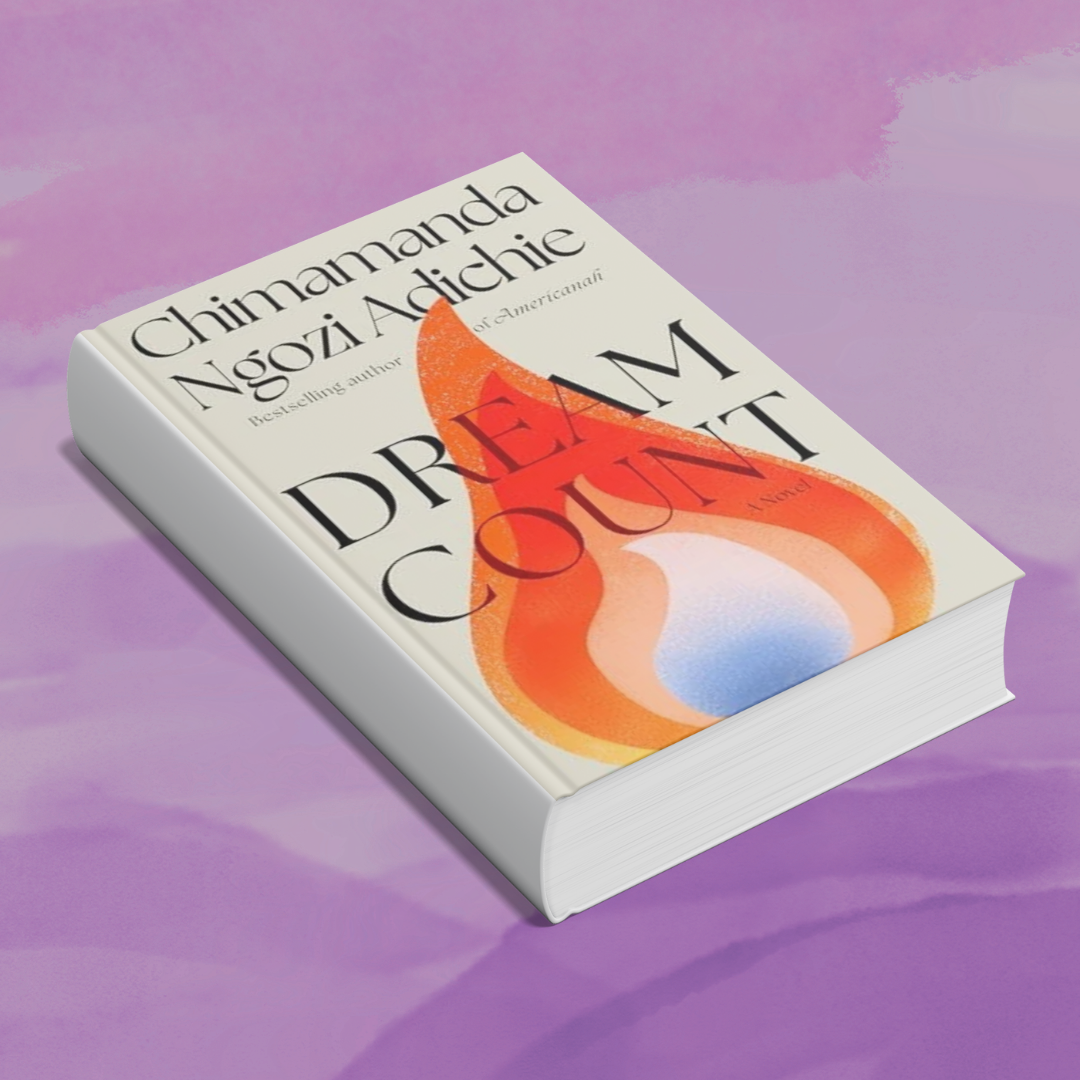
Dream Count by Chimamanda Ngozi Adichie
Genre: Literary Fiction | Published: 2025
Hello again! I’m back with another Chimamanda review. I wrote about Americanah some time last year, noting that while I enjoyed the book and really wanted to love it, there was a tone Chimamanda takes that I struggled with. I wasn’t sure if this was unique to Americanah or an undercurrent in all her work, a journey I’ve set on to find out — more to come on this.
Dream Count was released in 2025 to much excitement. Her first novel in a decade—many book lovers waited with anticipation to see what Chimamanda Ngozi Adichie had to say next. I knew I’d read it the month it came out, but I wanted to bide my time, see a few reviews, gauge the vibe, before I decided whether to dive in. Fast forward to December: a good friend was reading it and asked me to join, so I added it to my December TBR.
It took me about 10 DAYS to finish Dream Count! Far longer than a 400-page book should take. I ended up switching to the audiobook because I suspected this might be a bit of a slog, and nothing gets me through that better than listening. I have so much to say about this book that I’ve actually found it rather difficult to articulate my exact feelings — a phenomenon I remember oh so well with Americanah. After lots of discussions with my friend and reading other reviews, I think I’m finally ready to share my full, honest thoughts on Dream Count, Chimamanda Ngozi Adichie’s latest novel.
Premise & Structure
Dream Count follows four interconnected women.
Chiamaka is a Nigerian travel writer living in America. Alone in the midst of the pandemic, she recalls her past lovers and grapples with her choices and regrets. Zikora, her best friend, is a lawyer who has been successful at everything until—betrayed and brokenhearted—she must turn to the person she thought she needed least. Omelogor, Chiamaka’s bold, outspoken cousin, is a financial powerhouse in Nigeria who begins to question how well she knows herself. And Kadiatou, Chiamaka’s housekeeper, is proudly raising her daughter in America—but faces an unthinkable hardship that threatens all she has worked to achieve.
Rather than following a single linear narrative, each woman is given a few chapters to tell her own story, with other characters appearing briefly. The novel doesn’t centre on one moment in time; instead, it unfolds as a series of vignettes across the lives of these women, highlighting the moments that shaped them.
I have no issue with this structure, I’ve enjoyed many books that use it, such as Homegoing and Girl, Woman, Other. I appreciate character-driven stories over plot-driven ones, narratives that allow for deep human introspection. While Chimamanda delivers this in various forms, there is still much left to be desired.
Positives First
Chimamanda is a phenomenal writer—this I can never deny nor even attempt to undermine. She writes with such clarity of voice and is always deeply poignant in both what she wants to say and how she wants you to feel. She has never shied away from the hard or the painful, and her writing always carries a sharp, clear perspective, especially when it comes to Nigeria.
“I’m growing old and the world has changed and I have never been truly known.”
Chimamanda Ngozi Adichie
She thrives in the realm of social commentary. We know her for numerous non-fiction pieces on feminism, womanhood, and the realities of Nigeria and the post-colonial warpath. But what truly sets her apart is how she blends cultural and social commentary into her fiction, ensuring her books cannot and will not be read passively. She makes you think, feel, and question—not just what she’s telling you, but how you respond to it.
Dream Count is raw and unflinching in its characterisation. It weaves together a tapestry of women’s experiences in their many forms. It speaks to the reality of womanhood—often uncomfortable, sometimes unlikeable, but undeniably true for many living within a patriarchal and deeply misogynistic society.
Themes & Ideas
I was going to expand on the themes in the book and what Chimamanda seeks to explore; however, I think much of it is quite obvious, as she tends to revisit similar ideas across her works. This is not a criticism—I do the same when there’s a topic I’m passionate about. Dream Count is, at its core, about the experience of women, particularly African women—the fight to be seen as fully realised individuals with autonomy, who seek love, joy, and all the good life has to offer. It also confronts the reality of our flaws—the things that make us human: embarrassment and, most of all, shame.
Of all the themes I noticed, shame stood out as the most central and the one that truly resonated with me.
- Chiamaka’s shame lies in her inability to find a man who treats her as an equal. She repeatedly falls into the webs of men she knows she shouldn’t be with, yet cannot seem to choose better for herself.
- Zikora’s shame comes from being seen as an extra in every man’s life. When she finally finds someone she deems worthy, she ends up a single mother—a reality common in our communities, both at home and in the diaspora, and still viewed as a mark against a woman.
- Kadiatou’s shame is rooted in poverty and displacement—a refugee in a foreign country, barely speaking the language, her body violated by those who see her as less than, and ridiculed simply for existing in a Black African female body.
- Omelogor’s shame is more subtle. She doesn’t wear it openly; instead, it resides deep in her mind, where she questions who she is, the decisions she makes, and whether she is as good as she appears. Though far more secure in her womanhood—despite being childless and husbandless—her internal doubts linger.
Of all the ideas that Chimamanda explores the allconsuming nature of shame was probably the most fascinating to me and the only one that felt real but subtle and was approached with real nuance.
Characters
Besides Kadiatou, I didn’t like a single character, and I could go into a lot of detail about why. While I don’t need to like a character to enjoy a book, I do need a level of understanding that I simply didn’t get here, other than feeling they were designed to be this way. Almost all of them felt like a humiliation ritual.
I wished Chiamaka would get herself together and stop accepting bad behaviour from awful men. I know it was likely written for us to have a clearer view of her circumstances than she does, being in those situations—but honestly, it started to feel like Chiamaka was doing this on purpose, and at that point my sympathy ran out.
Zikora was pathetic, though in a sad way. I wouldn’t say her shortcomings were entirely her fault—she was definitely dealt a bad hand. I didn’t connect with her in any meaningful way, but I still felt some sympathy.
Omolegor’s story was boring, far longer than it needed to be, and she was, frankly, a bad person. It was incredibly frustrating to watch her pretend to be virtuous, playing this Robin Hood act while actively contributing to everything we despise about the Nigerian elite and corruption. I just couldn’t accept it. I know that while a seemingly realistic portrayal of those in power in Nigeria: that steal from the country but help select individuals to absolve themselves of guilt, It didn’t land with Omelogor at all.
Kadiatou was the only character I truly connected with. Her story was devastating from start to finish. I hated what happened to her and was so frustrated when I saw the direction things were going—all I wanted was for one good thing to happen, rather than watching her be continuously beat down after doing everything she could to escape her beginnings. When I learnt she was based on a true story, my anger softened, but I still didn’t like how her situation was handled.
The Men
Honestly, as a proclaimed feminist and advocate for women, I find Chimamanda’s ability to make every single man in her story villainous—the root of all the issues the women face—and yet somehow absolve them of any real responsibility quite frustrating. It’s as if she gives them this childlike ignorance about their actions, a dynamic we see all too often in society’s response to male violence.
Every man in this book feels like a caricature, created solely to serve the woman’s story. This isn’t to say a man’s perspective should be centred in a book about women, but can we at least make him feel like a real person rather than an evil boogeyman whose sole purpose is to sow discord?
Writing Style & Tone
My primary issue with this book lies in Chimamanda’s writing style. It often feels as though she’s beating us over the head with social commentary under the guise of storytelling. There is little nuance, no subtlety—she tells us exactly how she wants us to feel, lining up her arguments so we arrive at her conclusion.
Her personal voice comes through so strongly that it feels less like reading a novel and more like attending a seminar. These characters should feel real, but instead, everyone, the women, the men, the family members, feels like a caricature, curated to fit the exact narrative she wants to deliver rather than allowing readers to form their own interpretations. The book becomes one long introspection on identity and culture as Chimamanda sees it, and therefore as we must see it too.
Now, I’m not saying I disagree with all her sentiments, but she doesn’t make these people real enough to dissect. She offers them up, already cut into neat pieces and says, “Here you go—I’ve done the work for you.” That isn’t the experience I want from fiction. Chimamanda is one of those authors whose message you cannot miss because she never gives you the opportunity to.
Her portrayal of American liberal academics—and particularly her very unfavourable view of Black Americans—is striking. I noticed this in Americanah, and it’s the same here. Now, I will never defend Americans when it comes to their ignorance about African realities, but as in Americanah, the way she discusses them and the tone she adopts feels harsh and unrelenting.
There is no nuance in her descriptors. And while I’m someone who believes nuance doesn’t always need to be spelled out because it can be implied, with Chimamanda it never is. She writes as though her view is absolute. While that might be acceptable for certain issues where fact is fact, this is a novel—not non-fiction. The entire book feels didactic and, at times, almost patronising in tone.
Final Thoughts
As I mentioned earlier, I’m on a mission with Chimamanda—to make a fully informed decision about her books and her writing. At the moment, she’s two for three on the issues I usually have with her work. I can’t say I didn’t enjoy Dream Count; while I found it boring and sluggish in parts, there were moments and stories I genuinely appreciated. Certain sections spoke to me, and I particularly liked the COVID-19 backdrop being used as a time for introspection that drives the narrative.
I initially gave this book three stars, but after some reflection, I’ve upgraded it to.
Would I recommend you read it? Absolutely. I don’t think it’s a bad story, and others may not feel as strongly about the issues I found. I still like Chimamanda, but so far this is definitely her weakest novel. My instinct right now aligns with a tweet I saw recently: She’s an exceptional writer but a subpar storyteller.
I recently read Purple Hibiscus, which I really enjoyed and connected with far more—so my exploration continues!
I hope you enjoyed reading this review, and a big shout-out to my friend Tilly for not only urging me to read this but also helping me articulate my thoughts and offering her own. Half the joy of reading is in the sharing.
Thanks so much for reading, and see you in the next post!
Signed,