
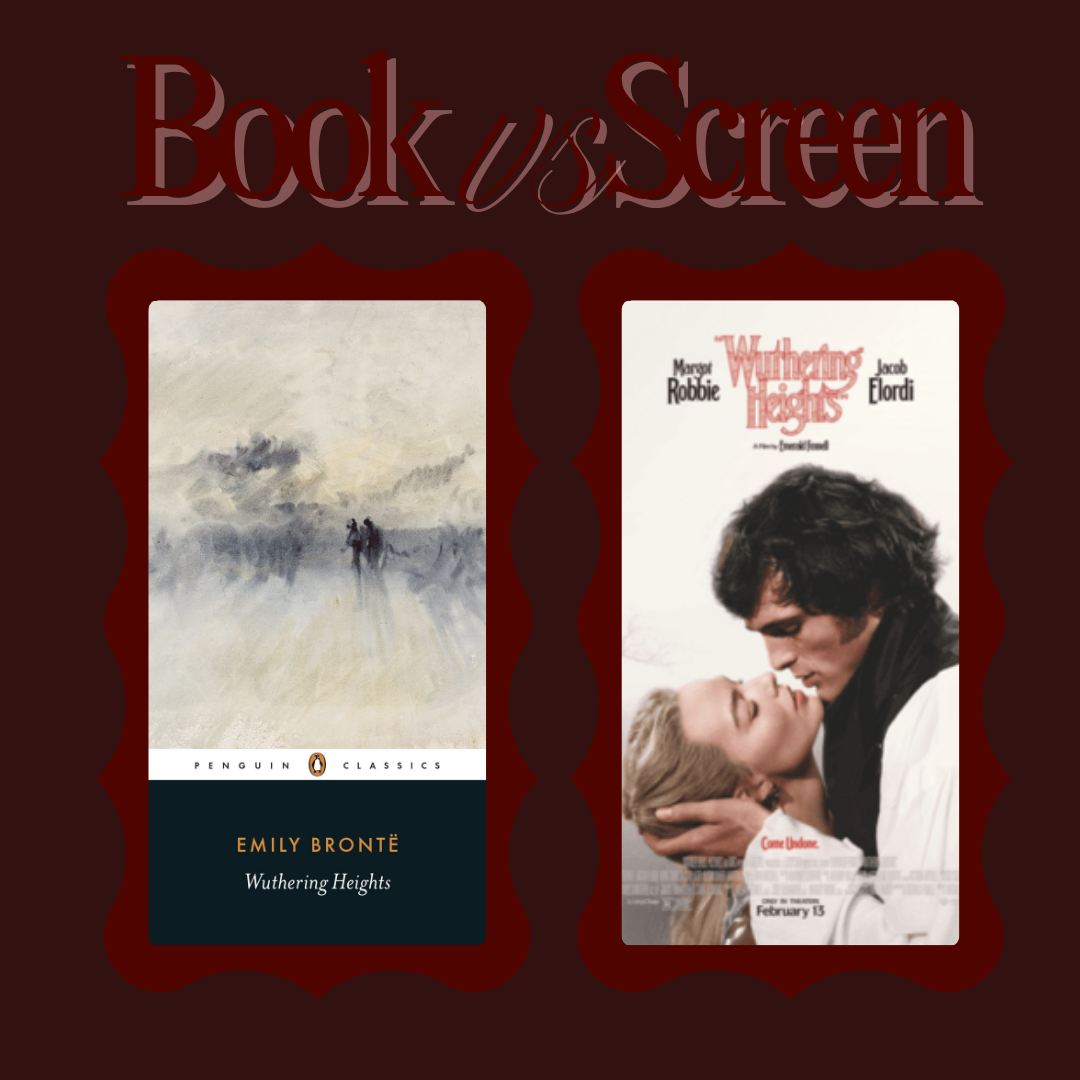
Wuthering Heights by Emily Brontë
Book Published: 1847 | Movie Released: 2026 Genre: Gothic Fiction | Classic
Like many of us, I first “read” Wuthering Heights in school. I say “read” because, let’s be honest, I didn’t really read it at all, as English Lit usually goes. The book then resurfaced on my radar with the release of the 2026 film adaptation, directed by Emerald Fennell. Even as someone who hadn’t truly read the novel, I walked out of that movie knowing, for a fact, that was not the story Emily Brontë wrote.
As a book blogger, every time I watch a book-to-screen adaptation, my first instinct is to write a “book vs. screen” post. I decided to revisit Wuthering Heights and actually read it so I could form a fully informed, well-rounded perspective on this adaptation.
It’s still Women’s History Month, and it’s not every day we get book-to-screen adaptations written, directed, and produced by women. So why not take a deep dive into the story of Catherine Earnshaw and Heathcliff, and explore how their ill-fated love rippled through and ruined generations of their families? Then, how Emerald Fennell took that story and made it her own.
Initially, this was meant to be a standard “book vs. screen” post like all the others on my blog—the kind where I compare changes, similarities, and tones, and ultimately decide which version I prefer. However, Wuthering Heights, as Emerald Fennell herself will tell you, is loosely based on—a reimagining, if you will—of Emily Brontë’s novel. As a result, I don’t think the two are particularly comparable.
For that reason, this post is structured as two reviews in one. I genuinely want to review the book I finally read, but also the movie as well and how I felt about reimagining this damned relationship as a genuine romance.
Synopsis
Wuthering Heights by Emily Brontë is a Gothic tragedy focusing on the intense, destructive, and obsessive relationship between Heathcliff and Catherine Earnshaw on the Yorkshire moors. Raised together, their inseparable bond is broken when Catherine marries Edgar Linton for social status, driving a betrayed Heathcliff to seek ruinous vengeance against both their families.
What follows is a multi-generational story of how one ill-fated relationship damned two generations of two families.
The Book: A Gothic Epic
I listened to a majority of the book via audiobook ( a great experience), just because it helped me get through it while I was doing other things, but I also made sure to read it physically to get a good feel for the prose.
I really enjoyed the book. I found it difficult at first to keep track of the fact that the story is actually being narrated until quite a few chapters in, and this narrative structure defines a majority of how the story is consumed—but I will get into that in more detail. Also all the characters have the same name or some rendition of the same name 😂, so it becomes difficult to keep track of who is who, so some would consider it a bit difficult to read. I wouldn’t say it’s an easy book to read due to the colloquial language used, but it’s also not written in Old English that is hard to wrap your head around.
As far as classics go, it’s probably been the most exciting one I’ve read. There is so much going on. I think my first sentiment after reading this was: I thought this was supposed to be a romance? This is a sentiment my friend Ola and I reject wholeheartedly. Nothing about this story is romantic—at least not in a traditional sense. I know it’s technically a gothic romance, which shifts the definition of romance in this context, removing traditional romantic tropes like courting, tender moments, and yearning. This relationship is defined by deep obsession, cruelty and selfish passion, not a healthy love.
Also, we don’t get to see and experience the actual relationship in detail because it is being narrated by a second-hand and sometimes even third-person account, so we do not know what characterises that intense emotional bond outside of shared childhood trauma. This is actually what lessened the book for me slightly, as I’m really not convinced by the love that drove the obsession. That said, the book is very fascinating, a train wreck in slow motion with horrible people being horrible to each other and extremely horrible things happening as a result.
Narrative Structure
The fact that we’re being told the story by second-party participants is my favourite part of experiencing this novel. We are reading Lockwood’s account of everything that Nelly tells him, which means there are two levels of unreliability at play. We cannot be sure if everything we’re hearing is the absolute truth or a biased version.
This is especially true of Nelly, who may not necessarily be purposefully misleading us like other unreliable narrators, but she is simply not very sympathetic, whether she’s biased for or against a character, so it leads us to question the validity of her claims.
We, as an audience, are forced into awareness, repeatedly, of the flawed nature of Nelly’s interpretations and of the distances that lie between what we are reading and what the story actually is. It is precisely this awareness which challenges us to take nothing at face value and, just as Lockwood is determining this family and meaning we too have to be active participants. We have to determine for ourselves what is true, what is an embellishment and what is downright false.
Character Analysis
Heathcliff
Heathcliff is portrayed as a villainous tyrant, engaging in severe abuse, revenge, and cruelty. It is definitely understood that following Mr Earnshaw’s death, he suffers at the hands of Hindley and his wife. I understand him wanting to get revenge, and honestly, the way he enacts it—you almost have to appreciate the level of cunningness and depravity that he showcases.
As for his obsession with Catherine and subsequently her descendants, it is rather interesting the way in which his love manifests. Nelly portrays him as sinister from the onset, and his subsequent behaviour is a stronger representation of his core nature, heightened by his abuse. However, from their first interactions, Nelly is particularly unsympathetic to Heathcliff, and we cannot be sure of the accuracy of her initial representations. We also have to question the true motives behind his actions and whether or not he actually did love Catherine, or was simply just obsessed with her.
“Be with me always – take any form – drive me mad! only do not leave me in this abyss, where I cannot find you! Oh, God! it is unutterable! I can not live without my life! I can not live without my soul!”
heathcliff
Catherine Earnshaw
Catherine is characterised to be wild and passionate, very much Heathcliff’s other—two sides of the same coin. However, I considered her to be rather annoying and petulant. Despite her ageing considerably from the beginning of the book to her death, she largely remains the same, with very little development.
Her death happens quite early in the novel (about fifty per cent of the way through), which I was glad to see; however, her spirit does linger till the very end. She is my least favourite character in the book. Not that I particularly liked any of them.
“If all else perished, and he remained, I should still continue to be; and if all else remained, and he were annihilated, the universe would turn to a mighty stranger.”
catherine earnshaw
Themes of Trauma
Through Heathcliff, we get a somewhat layered look at generational trauma and its effects. Heathcliff is essentially reproducing his own traumatic past—the stigma of his racial ambiguity, his lineage, and the casual abuse and cruelty he experienced—in others.
While I do want to feel sympathetic toward what he endured and who he became, my sympathy is capped. I hurt even more for the children born into this clusterfuck through no fault of their own, being punished for generational hatreds that preceded them. Emily Brontë twists the home and domestic spaces—what should be a site of family and love—into a prison, where emotional violence, evil, and struggle thrive.
Now, while I do see these elements in the prose, and I do believe this is a potentially reasonable conclusion, I don’t think Heathcliff as a character is complex enough for us to confidently reach this conclusion. He doesn’t come across as multi-dimensional as the story wants us to believe. This could be the fault of the narrative structure hindering us from being in proximity to his direct thoughts and feelings, but I did feel at times that I was almost at the cusp of getting that depth, but never quite reaching it, and eventually the story becomes quite dramatic by the end and loses the acuity we begin with. A fearless and profoundly resonant story, nonetheless.
The Film: A Classic Reimagined
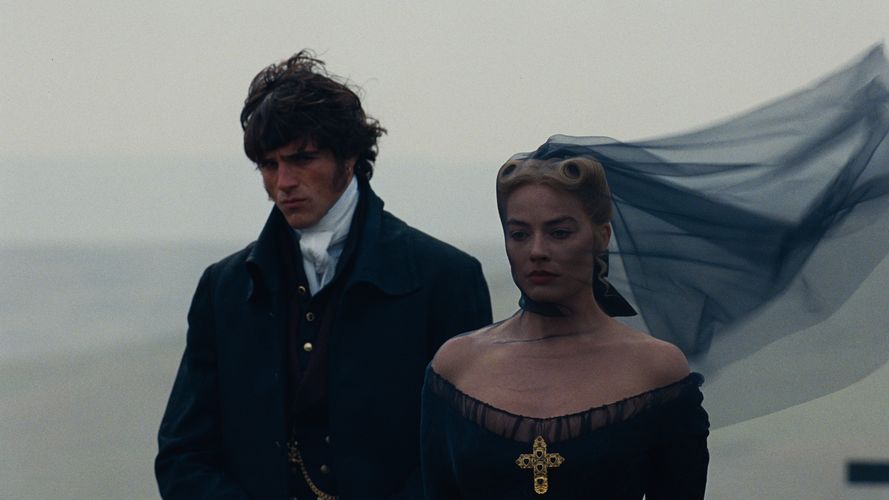
It is clear from the opening scene that Fennell takes significant creative liberties with the story she’s telling. From the jump—the hanging in the very first scene—the tone is set for a bold and unflinching tale. However, the changes don’t stop there. There are major differences from the novel too many to count: the characterisation of Catherine’s father, the circumstances under which Heathcliff comes to be a member of the Earnshaw family, and most importantly, the complete absence of Hindley Earnshaw.
This character being left out of the interpretation immediately shifts the story and therefore much of the characterisation around Heathcliff, that thematic exploration of trauma? Gone. Now, while he does still suffer to some extent under the tutelage of Mr Earnshaw—who is characterised here as a mean and violent drunk that the whole household suffers under—the dynamic is fundamentally different. This version of events is what inevitably leads to the damned but passionate relationship between Catherine and Heathcliff.
They find solace in one another from a young age and form a bond. As a result, Heathcliff’s responses to Catherine’s ‘denial’ of their love, while disproportionate, feel understandable and well-motivated. The subsequent events that follow also feel logical. Heathcliff runs away to elevate his status and returns to prove that she essentially made the wrong decision. The remainder of their relationship becomes a forbidden love, forever doomed by their unflinching passion for each other, a passion that simply cannot exist in the world that they inhabit.
Overall Impression
Overall, I enjoyed the film. This is what I would call Wuthering Heights fan fiction. This film was for the girlies who read Wuthering Heights as young teens and were scandalised by the obsessive nature of Catherine and Heathcliff’s relationship. It’s for those who wondered what could have been if their actual romance had been placed on the centre stage in the way it simply isn’t in the book. The scenes were salacious, scandalous and fun to watch.
Filmmaking Craft
Visually, this movie is stunning. The epitome of beautiful gowns (ifkyk). I think the cinematography is great and perfectly captures the gothic tone of the Yorkshire moors. It is melancholic, subdued, yet heavy and dramatic. The minute you suspend your expectations for a classic, faithful adaptation, it becomes a lot easier to consume and enjoy this movie for what it is.
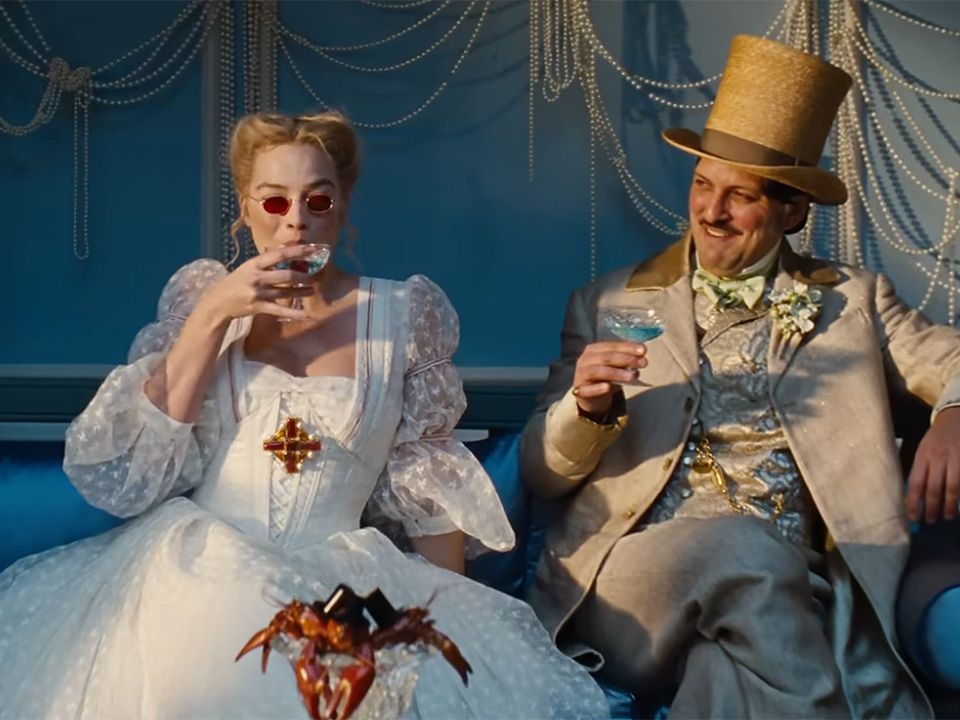
Characters
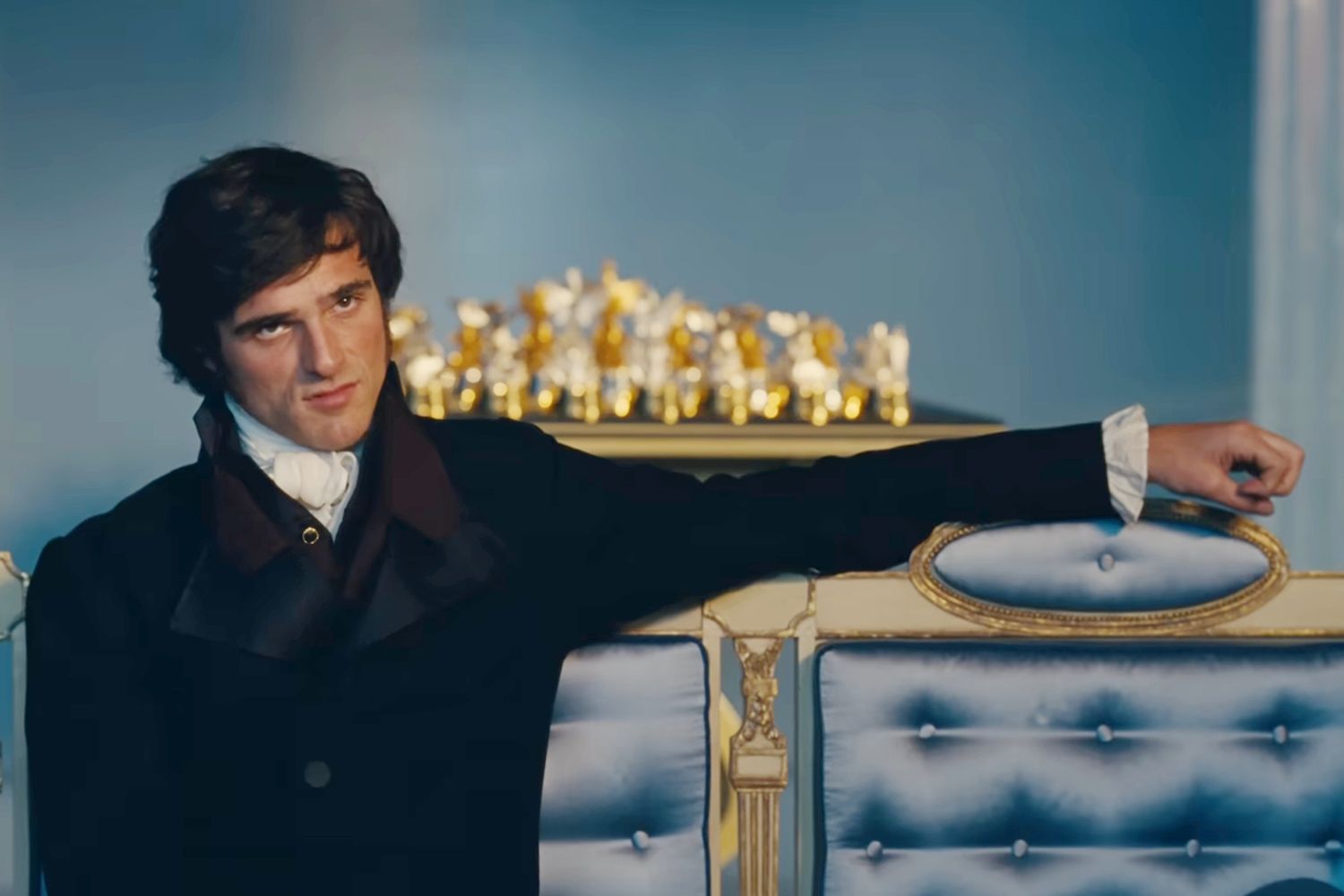
Performance-wise, I think Jacob Elordi does a stunning job at capturing Heathcliff’s sullen demeanour while still maintaining a palpable passion for Catherine. I know there was considerable online discussion about his casting and whether it was racially appropriate, given Heathcliff’s ambiguous heritage. I understand Elordi has Basque heritage, which may not be far removed from the origins Brontë herself imagined for Heathcliff. I will say, though, the online discourse about how “dark” he should have been feels slightly misplaced to me; he was never going to be a dark-skinned man.
Now, do I think Fennell should have cast a more racially ambiguous actor? Sure. However, this is a story being filtered through the imagination of a posh white woman. This isn’t to let her off the hook, but to say that, understanding the kind of creator Emerald Fennell is, helps to understand the kind of story she’s telling and her capabilities in digging deeper in this regard. I’m okay with this Heathcliff being a white man simply because I wouldn’t have trusted strong racial subtext in her hands.
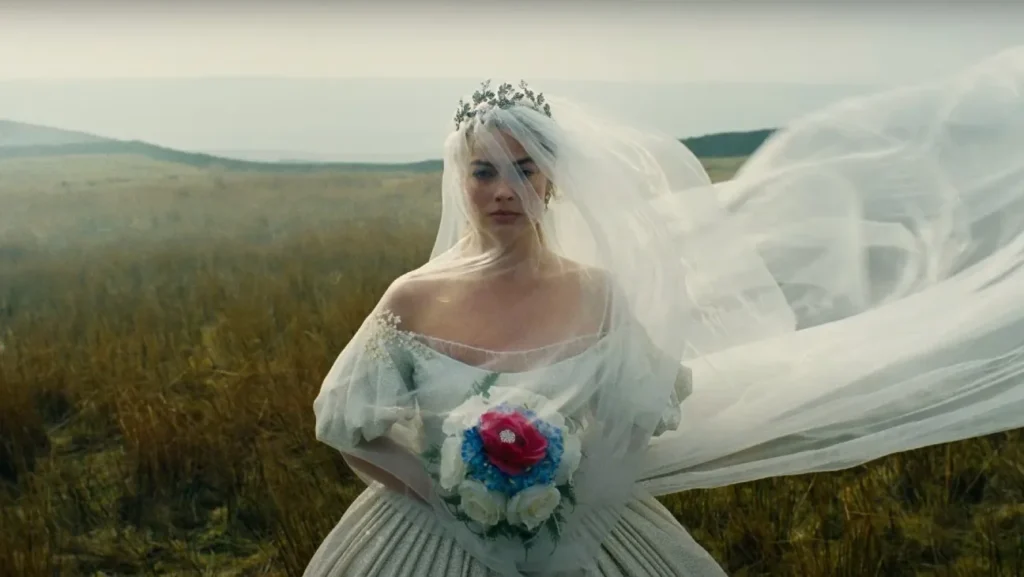
Margot Robbie—who I absolutely adore, by the way—is fine as Catherine. I guess? Nothing about the performance blows me away. My main issue is that I thought she was too old for the character, and as a result, that youthful brazenness that defines Catherine feels missing in this portrayal.
As for Nelly, her character—who is super important in the book—is rendered slightly less significant in the film and is ultimately reduced to being Cathy’s “opp.” The decision to make her Asian could be considered tone-deaf in the context, but in all honesty, I don’t know if anyone, director included, is thinking that deeply about this adaptation. So I can’t say this was necessarily a wrong decision on Emerald Fennell’s part.
The film was enjoyable, and anyone who has ever read—and enjoyed—a smut novel most likely lived for what they were watching.
Creative Liberties
Like I said at the beginning, comparing the two feels like a waste of time because they are simply not the story — it’s like comparing Hilary Duff’s ‘A Cinderella Story’ with the original Brothers’ Grimm Tale. Emerald Fennell completely streamlines the narrative to focus entirely on the romantic relationship between Heathcliff and Catherine. She cuts out everything from the book that doesn’t advance or relate to this plot.
If I’m being honest? I’m not mad at it. The title being in quotation marks kind of set the tone that this wasn’t going to be a faithful adaptation. Also, there already is one—in fact, I think there are two—faithful adaptations out there. I have nothing against reimagining and reinterpreting books, especially the classics. In my opinion, at this point in history, that’s exactly what we should be doing. There’s no real difference between this and Clueless, being a modern retelling of Emma, or the creative changes Baz Luhrmann took in his retelling of Romeo + Juliet. It uses the novel’s skeleton to tell a different story that resonates with contemporary audiences.
Now, as far as filmmaking itself goes, does Emerald Fennell strip out a lot of the deep commentary from the story? Possibly. Does the movie produce a level of introspection to a similar degree that the book does? Also probably not. So, the question becomes, outside of it being an adaptation, is it a good film? That’s open to interpretation. I think it’s okay. I don’t believe it offers much beyond a surface-level exploration of obsession and ill-fated love, set against a very passionate backdrop. I still enjoyed myself—but I did not feel the strong emotional resonance others did. It simply wasn’t a strong enough narrative for that.
Final Thoughts
I really enjoyed the book as an overall experience. I think it is a dark and sprawling epic which utilises really strong literary themes and makes you think and question so much of what you’re reading. I also enjoyed the movie because I love passion and romance—however ill-fated—and I was definitely blushing during many moments of the experience.
However, the conclusion I have come to is that despite these two works not being comparable as far as adaptations go, the book is a better book than the film is at being a film.
Now, though the film may frustrate purists, its existence has sparked renewed interest in Brontë’s original work, and that can never be a bad thing. People can always experience the original story for what it was, and perhaps the best way to experience them is to see the film first for its spectacle, then read the book to discover the true, unsettling depth of the story.
This has been such an exciting review to write. Shout out again to my friend Ola, whom I forced to join this experience with me. As always, the joy of reading will always be in the sharing. This post is now extremely long, so thank you for sticking with me. I hope you enjoy this, and let me know your thoughts. Please do have a look at my other Book vs Screen posts, and I’ll see you again next time!
Signed,




As a self proclaimed hater of the wuthering heights story I was not mad at the reimagination. However agreed the movie was an enjoyable watch mainly cause it was a spectacle. It took away the vivid emotions of the book(seeing as my main one was disgust)