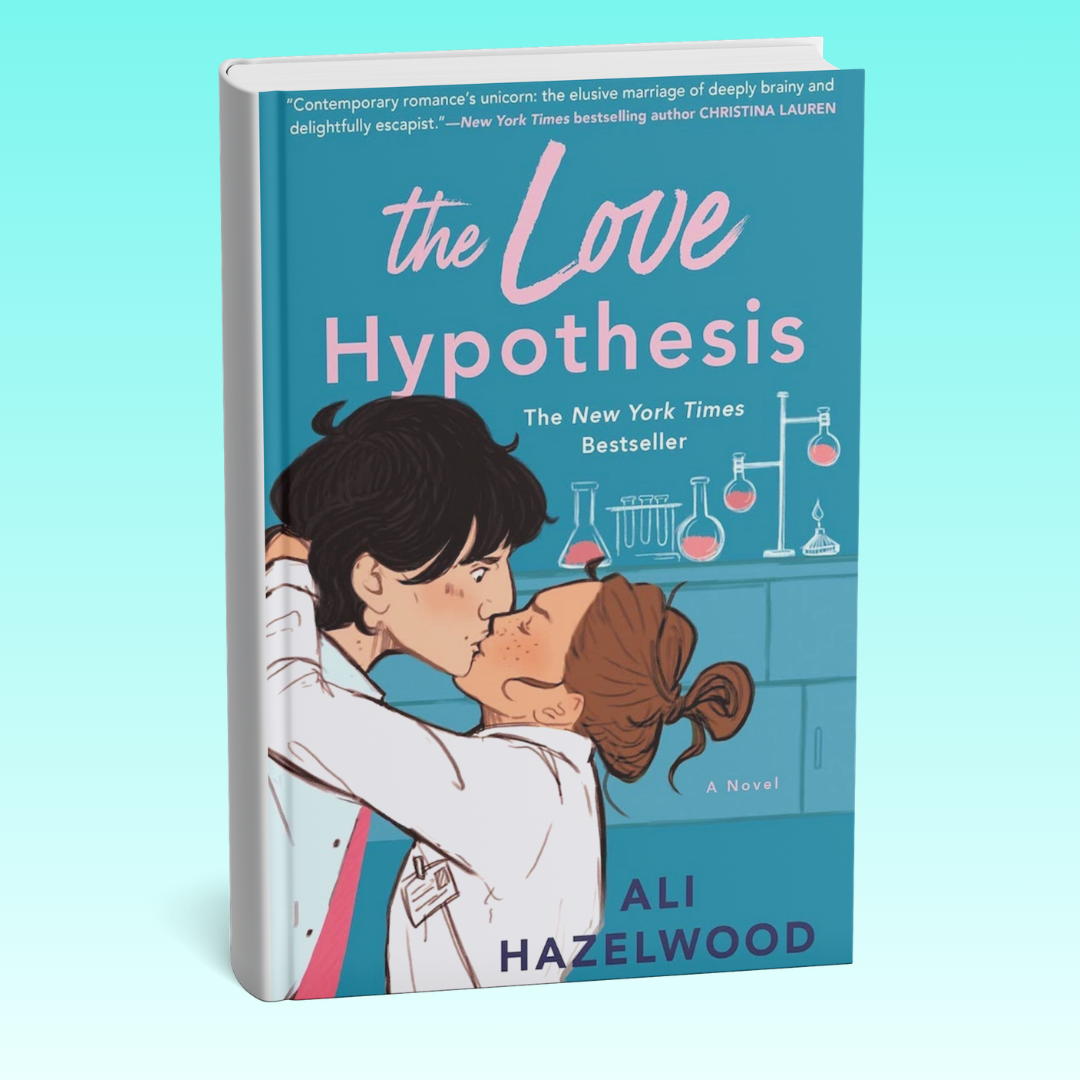
The Love Hypothesis by Ali Hazelwood
Genre: Romance | Published: 2021
For this review, we’re continuing in the spirit of my month of love, even though Valentine’s Day is now over and done with! I hope you all had lovely days with your loved ones.
I was always going to review another romance, but I was in two minds about which one to pick. I’ve talked about a few “booktok sensations” on this blog over the past few months, so I thought: why not stick to the theme for this romance review? There are many, many, many popular booktok romances, but whenever I search, the first and most persistent one that comes up is always The Love Hypothesis.
For some odd reason, I did not read The Love Hypothesis in 2021 like everyone else when this subgenre of romance was making headway. I read everything else—from The Kiss Quotient to The Flatshare, The Unhoneymooners, and The Spanish Love Deception—but never The Love Hypothesis. This was definitely an error on my part, because my brain is now far too developed to have enjoyed it in the same way I probably would have back then.
Anyway, I started reading it, and it took me three days to finish a 300‑page romance, which is very out of the ordinary for me.
I have very mixed feelings about this book, which I’ll unpack, but will say I enjoyed it toward the end, though it took me a bit to get there. And as I am likely one of the few people who are only just reading this now, this will be a spoiler‑filled review.
Summary
As a third-year PhD candidate, Olive Smith doesn’t believe in lasting romantic relationships – but her best friend does, and that’s how Olive ends up in this mess. Desperate to convince Anh she’s happily dating, Olive panics and kisses the first man she sees.
That man turns out to be Adam Carlsen, a brilliant young professor – and infamous lab tyrant. So Olive is stunned when he agrees to keep her secret and play along as her fake boyfriend.
What starts as a simple experiment quickly feels dangerously close to blowing up. And Olive realises that the only thing more complicated than a theory of love is risking her own heart.
Characters
A problem I tend to have with these kinds of romances now is that none of the characters feels or behave the age they’re supposed to, least of all Olive. She comes across as incredibly juvenile and emotionally stunted for a 26‑year‑old, let alone a PhD student. The whole kissing-a-random-man-to-avoid-having-a-mature-conversation-with-your-best-friend thing is a bit… Can we all be adults here, please?
I actually rather liked Adam (or rather, the version of Adam I decided he was). I’m always down for a grumpy–sunshine dynamic. But I really didn’t like how Adam was portrayed in practice, particularly in his role as a professor. The moment we learn more about his background, he seems like he should be the complete opposite of how he behaves, and the contradiction leaves him feeling more vapid than Hazelwood probably intended.
It’s difficult to reconcile the person we’re told he is—based on his experiences—with the way he treats students. I wanted to understand how someone who’d had a horrendous supervisor ended up adopting similar behaviours. The explanation doesn’t quite land; I see what she was aiming for, but it doesn’t quite work, and he ends up seeming just as much of an arse.
That said, funnily enough, I honestly would have preferred the story from his perspective rather than Olive’s. She felt incredibly lacklustre, and at so many points in the plot, I found myself thinking, “Hmm, I wonder how he’s feeling about all this.” Even during the major conflict, it felt like the story would’ve been far more compelling if we’d been in his head rather than hers.
Writing Style
The writing style is extremely juvenile for a story centred around adults doing VERY adult things. It honestly felt like I was following a group of teenagers—from the dialogue to their interactions. Fake dating as a trope already toes the line, but I genuinely believe it can be done maturely, and I just didn’t get that vibe here. Everyone, especially Olive’s group of friends, felt very childish, and moments like Olive having to rub SPF on Adam had me thinking: can we please all be so for real and act our ages?
What Worked Well
I will say the book was very funny at times; some of the situations Olive found herself in genuinely made me cackle. There was a lot of heart in the story—heart that would have come across stronger with better writing… I digress. After the major conflict (Tom being an asshole), I found myself far more invested. I really enjoyed that storyline and how it played out.
It did go from zero to 100 incredibly fast, though; nothing in the book’s tone suggested sexual harassment or assault, and then it’s suddenly dropped on you, and everything spirals very quickly. I did appreciate Hazelwood’s attempt to explore the superiority complex in academia, the realities of male‑dominated fields, and the power imbalances they create—but it did fall slightly flat. I think Hazelwood could have handled it better, but I did enjoy this part of the story.
Handling of the Trope
An important part of the fake‑dating trope is that the protagonists spend so much time together that real feelings start to develop. Here, we’re told Olive is in love halfway through the book, and I could not tell you why or on what basis. They’d spent a handful of moments together and shared a few secrets—enough to justify a crush, maybe, but not love and definitely not a relationship.
I could see more clearly why Olive liked Adam, but I genuinely cannot tell you why Adam liked Olive. I know next to nothing about her besides her family history, her personality left a lot to be desired, and I just couldn’t see the connection besides it’s a romance, and they’re supposed to be together.
Other Issues
This book is so sciency. Normally, as a science babe myself, I have absolutely no problem with this. I also have zero issues with specialist topics when they fit the narrative and enhance the story—I remember wanting to be an astronaut after reading Atmosphere and feeling like everything about astronomy and space was used so well in the writing that I felt the passion very deeply. But this? It was boring, especially at the beginning. It took what is already kind of dull and made it mind‑numbing. There was just nothing to latch onto in those early chapters.
Final Thoughts
I’ve since learnt this book started as a Wattpad story, and you know what? That tracks. It has exactly the vibe you’d expect, and because of that, my critique kind of stops there. It might be hard to believe from everything I’ve said, but I did enjoy it in the end. I liked the central conflict, I liked how it was resolved, and everyone ends up happy. It took a while to get into, but the last third definitely hooked me more and didn’t feel like such a slog.
I’ve also heard that Ali Hazelwood’s writing improves in her newer books and that they’re far better. I’m not exactly in a hurry to find out, but I won’t completely write her off just yet.
This book earns a solid and maybe generous 3.5
And I leave you with my favourite line from the book – one I think everyone should adopt!
“carry yourself with the confidence of a mediocre white man”
The Love Hypothesis
Signed,