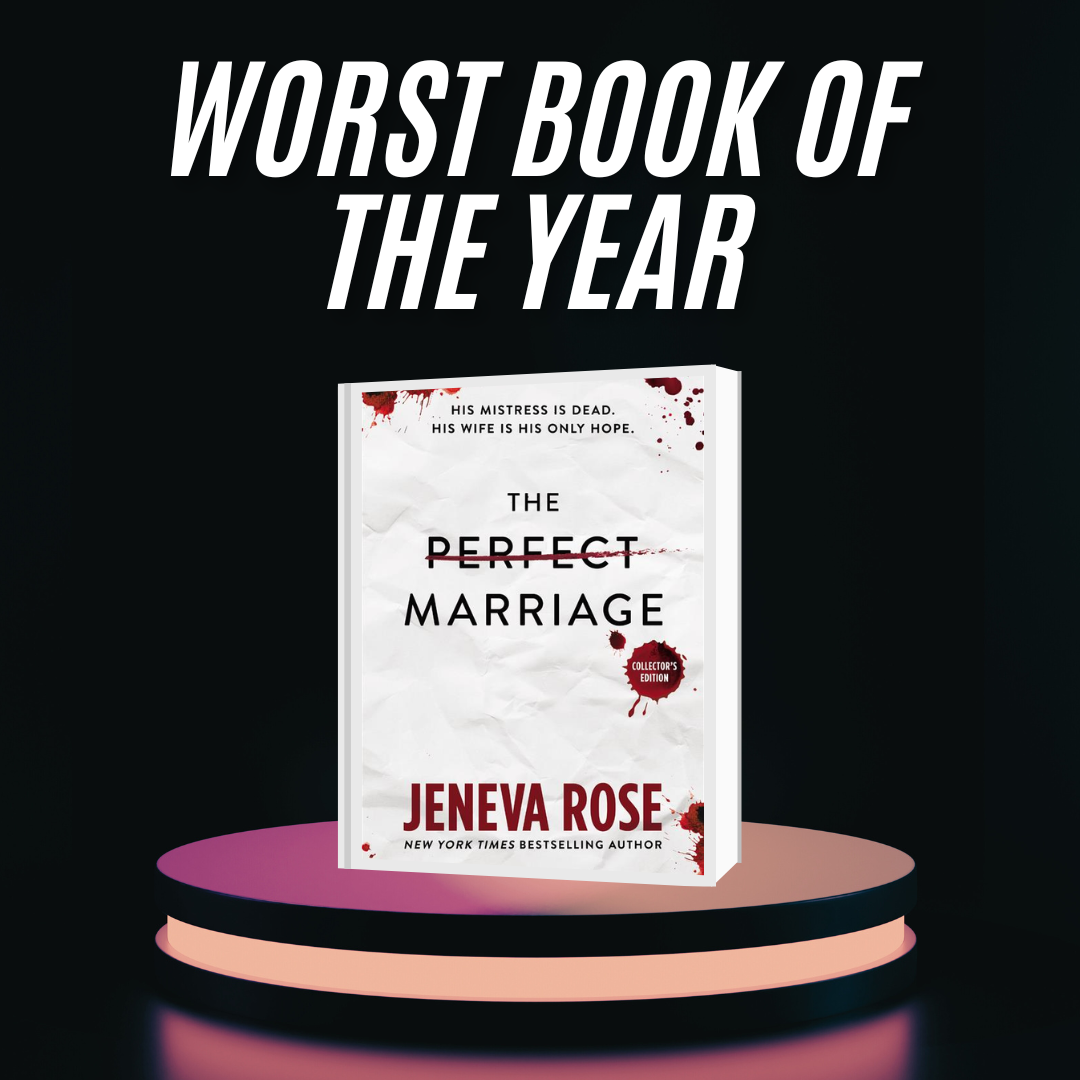
The Perfect Marriage by Jeneva Rose
Genre: Thriller | Published: 2020
My worst books of the year list arrived last week, and The Perfect Marriage by Jeneva Rose claimed the top spot on my ranked list with a brutal 1.5 stars out of 5. It is incredibly rare for me to say I genuinely cannot understand how a book has been rated five stars by so many readers, but here we are. I’m a firm believer in reading for entertainment, yet this one completely lost me. A 3.95 average on Goodreads, with 35% of ratings sitting at five stars? I was baffled.
I went into this book with genuinely high hopes. I loved the premise and expected a sharp, twisty thriller. Instead, as the story unfolded, I found myself repeatedly questioning what I was reading. The characters are atrocious, not in an “unlikable but compelling” way, but in a plainly badly written, poorly developed way that made it impossible to care.
This will be a spoiler review, as there are elements I need to unpack that cannot be discussed without giving things away. If you’re planning to read this, consider this your warning, but honestly, I’d urge you not to waste your time.
This is also a shorter review than usual. The book simply doesn’t deserve a 2,000-word deep dive like my other reviews. It’s not worth that much of my energy or my brain power.
Premise vs Reality
The Perfect Marriage follows Sarah Morgan, a successful and powerful defence attorney in Washington, D.C. At 33 years old, she is a named partner at her firm, and life is going exactly how she planned. The same cannot be said for her husband, Adam. He is a struggling writer who has had little success in his career. He begins to tire of his and Sarah’s relationship as she is constantly working.
Out in the secluded woods, at Adam and Sarah’s second home, Adam engages in a passionate affair with Kelly Summers. Then, one morning, everything changes. Adam is arrested for Kelly’s murder. She had been found stabbed to death in Adam and Sarah’s second home. Sarah soon finds herself playing the defender for her own husband, a man accused of murdering his mistress.
This is, on paper, a very strong premise and the sole reason I picked up the book. The idea of a wife defending her cheating husband immediately ticks a lot of boxes for me. Of course, in the real world, it would raise serious ethical concerns and represent a glaring conflict of interest, but as a fictional setup, it had me completely hooked. The opening is strong and engaging, but unfortunately, it doesn’t take long for everything to unravel.
Writing & Execution
The writing itself is wildly inconsistent and desperately needed several more rounds of editing. While the grammar is occasionally questionable, the bigger issue lies in the execution of the thriller elements. The plot is riddled with holes so large they’re impossible to ignore. There’s a complete lack of depth and believability, and the narrative struggles to maintain any internal logic. Character development is virtually non-existent, making it difficult to invest in anyone on the page.
The police investigation is particularly egregious. Adam is charged based on evidence that is flimsy at best, despite the presence of someone else’s DNA at the crime scene—a detail that is never meaningfully questioned. Sarah somehow has a stronger grasp of the case than every detective involved and repeatedly makes leaps of logic that no trained officer appears capable of. Every attempt to justify the shoddy investigation feels absurdly convenient, and none of it stands up to even the slightest scrutiny.
Characters
The dialogue and character work are an absolute mess, reading as immature and poorly thought out. Not a single character behaves in a remotely believable way. Everyone is written as painfully incompetent, but the husband—also the main suspect—is by far the worst offender. His behaviour is inexplicably moronic, to the point where it feels like he’s actively trying to incriminate himself. Every choice he makes works directly against him, with no logical motivation behind it.
His mother is equally insufferable, and many interactions feel completely nonsensical. At times, the book reads less like a serious thriller and more like a strange parody of the genre.
Sarah herself is deeply unpleasant, which retrospectively aligns with the ending, but even then, the way she treats other women is grating and poorly handled. We’re given virtually no insight into Adam and Sarah’s relationship beyond mutual contempt, which means there’s no emotional grounding and no reason for the reader to feel invested in either of them.
The supporting cast is thrown in haphazardly, with most side characters serving no real purpose in the narrative. It feels as though they exist simply because Jeneva Rose didn’t know what to do with them, rather than because the story demanded their presence.
Perhaps most frustrating of all is the portrayal of law enforcement and legal professionals. Not a single police officer or attorney behaves with even a shred of professionalism. They’re depicted as seedy, aggressive, or outright incompetent, giving the overwhelming impression that the author has little to no understanding of criminal investigations or court proceedings.
The Ending
We eventually learn that the wife was the killer all along, having orchestrated the entire situation to rid herself of her useless husband. I’m extremely picky when it comes to first-person thrillers where the culprit is also the narrator. Being inside the killer’s head means only so much can be hidden from the reader.
I’m not saying it can’t be done; first-person protagonists can be the murderer, but it requires a carefully constructed unreliable narrator: misdirection, withheld memories, self-justification, or subtle distortions that make the reveal snap into place retrospectively. None of that happens here. Sarah is never established as unreliable, and when the truth is revealed, it simply doesn’t align with the story we’ve been told.
Instead, the book asks the reader to suspend an unreasonable amount of disbelief. The twist doesn’t feel earned, logical, or even particularly clever. It’s propped up by an overwhelming number of red herrings, none of which are used effectively, leaving the ending less shocking and more frustrating than anything else. All the characters act one way for the entire book, then turn to the audience and mwahaha at the end, like, can we be so serious?
Final thoughts
I’m genuinely unsure who The Perfect Marriage is meant to appeal to, even though plenty of people clearly enjoyed it. The Perfect Marriage is, quite simply, a perfect mess. Its only redeeming quality is its length—at just a couple of hundred pages, I didn’t have to spend more than a few hours enduring the chaos.
This was the easiest choice for the worst book of the year by a long shot. And somehow, even now, it still crosses my mind. In a strange way, that lingering presence is almost impressive, that despite every attempt to rid myself of it, it still manages to stay in my consciousness.
I read some really great reviews on GoodReads that all really encompass exactly how I felt, and some were hilarious, so give those one-star ratings a read!
Thanks for reading, and see you on Wednesday for my end-of-year wrap-up!!
Signed,