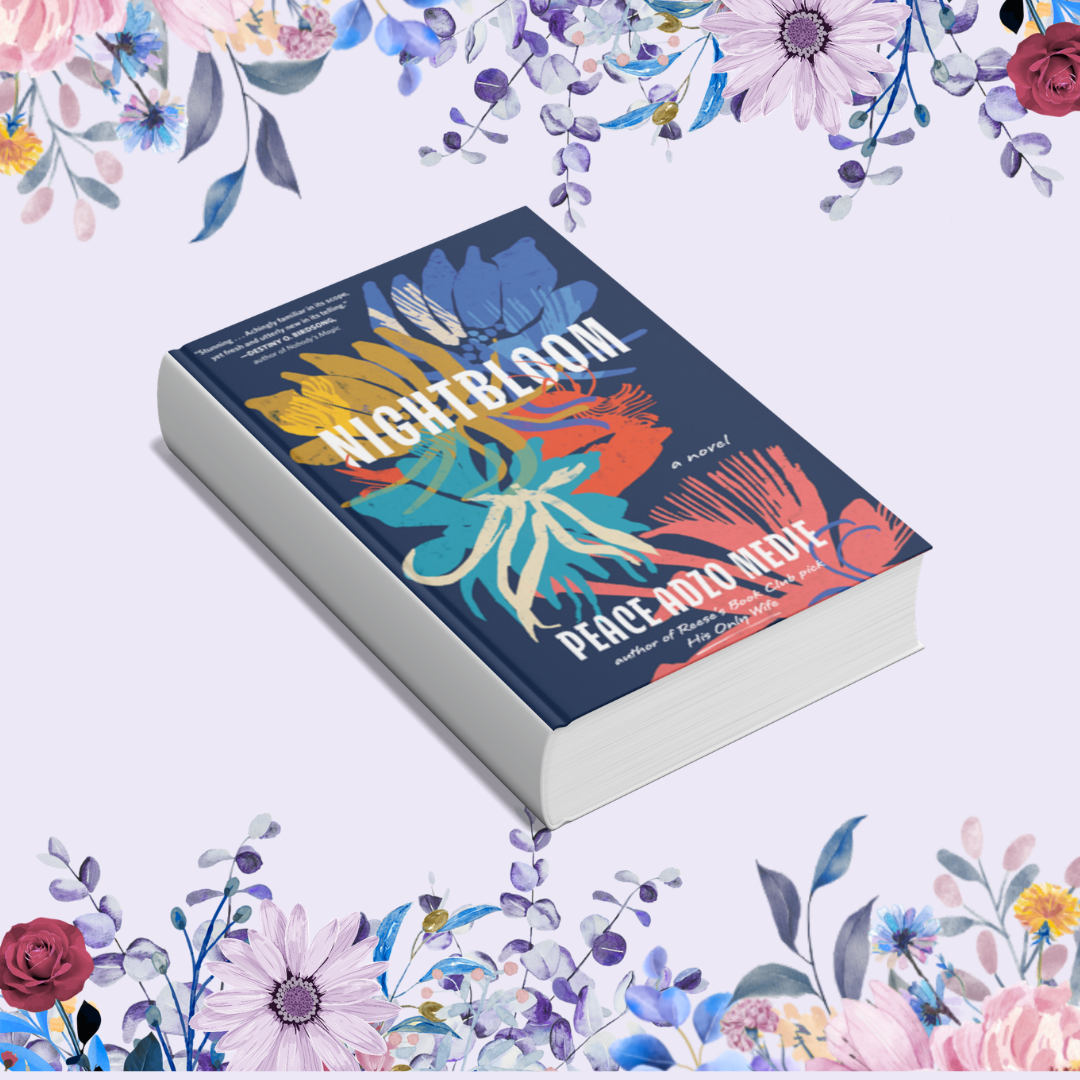
Nightbloom by Peace Adzo Medie
Genre: Contemporary Literary Fiction | Published: 2023
For my final post celebrating Women’s History Month, I found myself torn over which book to review. I’ve explored various facets of womanhood throughout the month, but one aspect I hadn’t yet touched on was friendship—both its beauty and its complexity, and the profound role it plays in women’s lives. Determined to fill that gap, I set out to find a book that captured this dynamic in some form.
Initially, I chose one to read, but over the past few weeks, reading hasn’t been a priority for me. To make matters worse, I wasn’t enjoying the book I’d selected, and I began to doubt I’d finish it in time to write a meaningful review. So I went back to searching for books centred on friendship, and that’s when I rediscovered Nightbloom by Peace Adzo Medie, a book I read last month. This novel weaves together themes of friendship, family, and sisterhood against a rich backdrop of racism, colonialism, and misogyny, and it turned out to be exactly what I was looking for.
Friendships are often the bedrock of womanhood. They offer deep understanding, validation, and safe spaces for vulnerability. For many women, a close friendship is the first time they experience being loved and cared for wholeheartedly by someone outside their immediate family. These bonds create a sense of community and love that is not only emotionally validating but also provides physical and mental protection.
Nightbloom explores the friendships that raise you and simultaneously undo you in ways one may never recover from. It is an intimate, tense, and reflective novel about a foundational female bond, and what it costs to try to carry that bond into adulthood, in a world that consistently pits women against each other.
Premise
When Selasi and Akorfa were young girls in Ghana, they were more than just cousins; they were inseparable. Selasi was exuberant and funny, Akorfa quiet and studious. They would do anything for each other, imploring their parents to let them be together, sharing their secrets, desires, and private jokes.
Then Selasi begins to change, becoming hostile and quiet; her grades suffer, and she builds a space around herself, shutting Akorfa out. Meanwhile, Akorfa is accepted to an American university to become a doctor. Although hopeful that she can create a fuller life as a woman in America, she discovers the insidious ways that racism places obstacles in her path once she leaves Ghana. It takes a crisis to bring the friends back together, with Selasi’s secret revealed and Akorfa forced to reckon with her role in their estrangement.
Friendships Across Class
One of the things Nightbloom examines is how often female friendship is strained by difference—particularly differences of class. The novel makes clear that the innocence of adolescence is rarely preserved as we grow older, and that the realities of adulthood inevitably complicate even the most genuine and transformative relationships. No matter how deep the bond, friendship is repeatedly tested by structural inequalities, especially class, which continue to exert pressure long after childhood intimacy has faded.
Despite the fact that Akorfa and Selasi are cousins and that their friendship begins in the safety of childhood intimacy, it is clear from very early on how material and structural inequalities shape their relationship. Akorfa grows up middle-class and is afforded a level of security and opportunity that Selasi is not, even as Selasi’s mother does everything she can to ensure that this difference is not immediately apparent to her child.
Despite this, Selasi is initially the more outgoing friend—the one Akorfa looks up to. As they grow older, however, and their class differences become increasingly visible, the perceived power imbalance between them begins to shift. Akorfa is granted not only a more stable lifestyle but also the privilege of being able to focus on school, allowing her to accrue social capital through education, even when financial control is not directly in her hands.
For Selasi, the early loss of her mother strips away the protective layer of childhood far sooner. Exposed to the realities of life at a much younger age, she is unable to benefit from the developmental shelter that adolescence often provides. Instead of being afforded the space to focus on self-development in the ways expected of girls her age, she is forced to worry about survival and stability.
As a result, the social capital that intelligence and academic promise might have offered works against her rather than for her, pushing her to seek validation and security elsewhere, most notably through boys. This divergence almost inevitably severs the bond between the girls, as they no longer look to each other for affirmation, but instead seek it in entirely separate places.
All of this is compounded by the fragile foundation of their relationship, which is largely shaped by both girls’ relationship to Akorfa’s mother. She exerts quiet but significant control over the terms of their friendship, pulling the strings in ways that continually—and often unintentionally—test Akorfa’s loyalty, forcing her to choose between the emotional support of her mother and commitment to her best friend.
“My only comfort had been the knowledge that she and I would soon part. But when she finally left, I mourned the friendship that had cradled us, our own iridescent world within this sometimes gray one”.
Peace adzo medie
Friendship as Refuge
Despite the very real class differences and social positions that separate Akorfa and Selasi, Nightbloom ultimately shows that class does not protect women from the harms and dangers of misogyny and patriarchy. Both women suffer at the hands of the same man at different moments in their lives, underscoring the limits of status, education, and perceived respectability as forms of protection. Akorfa, focusing on her books and not being ‘wayward’ as Selasi was described, does not stop her from suffering the same fate.
Despite the fractured state of their relationship by the time secondary school ends and Akorfa leaves for university, they continue to seek each other out emotionally in these moments of crisis. Their bond demonstrates how friendship functions as a space of emotional safety, shared language, and protection against isolation despite distance. As they grow older, move on, and form new relationships, the absence of the friendship that defined their formative years becomes its own distinct form of loss.
In moments of profound harm—particularly harm experienced by women—friendship becomes a site where validation and survival are possible. Women rely on one another to affirm their realities and to bear witness to experiences that others may dismiss or refuse to acknowledge. When that support is absent, the isolation can be devastating. Throughout the novel, Akorfa repeatedly cries out—implicitly and explicitly—for support by the women in her life and the reality that the one woman she knows would have believed her and stood beside her when no one else did is absent.
Even in its fractured state, that friendship remains a touchstone: proof that someone once saw her fully and understood her pain. Friendship in Nightbloom is not romanticised, nor is it presented as consistently comforting or redemptive. Instead, it is raw, complicated, and shaped by the same social pressures that strain romantic relationships. In Nightbloom, friendship is not a soft escape from the world, but a shelter built within it—one that can collapse, often does, but can be rebuilt.
Structure & Writing Style
One thing I particularly admire about Peace Adzo Medie’s writing is the clarity and precision of her prose. Her stories are not necessarily difficult to read, yet she never shies away from emotionally layered and nuanced narratives that demand careful attention. Medie has a quiet confidence in her storytelling: she guides the reader exactly where she wants us to land, often without making it obvious that this is what she is doing. The effect is subtle and deeply effective, encouraging reflection rather than dictating interpretation.
That said, there are moments where her writing edges toward the preachy; it feels less like guidance and more like being hit over the head. These moments tend to appear in sections dealing with broader structural issues—racism, misogyny, and systemic injustice—where the messaging is at its most explicit. By contrast, the more intimate, emotional aspects of the story are handled with far greater care and restraint.
The balance in her writing becomes especially apparent in the novel’s split narrative structure, where we read Akorfa’s and Selasi’s experiences of the same events from their respective perspectives, up until the point where their lives diverge. Akorfa’s narrative is written in language that is sharp and often harsh. Her worldview reflects the anger and rigidity her mother inherited from her own upbringing and, in turn, imposed on her. While it is easy—at least initially—to side with Akorfa and her family’s version of reality, beneath this assertiveness runs an undercurrent of cruelty and imbalance, a quiet sense that not everything is as it seems.
This unease is quietly seeded through Medie’s tone and diction, and it is later validated when Selasi’s narrative reframes those same moments from a position of vulnerability and exclusion. Through careful control of language and perspective, Medie leads the reader through a process of complicity and reckoning, using voice itself as a moral guide.
Critiques
I really enjoyed the book, though the characters—especially Akorfa and her mother—were extremely frustrating at times, and it was clear that the story I was reading definitely had two sides. Despite my initial sympathy for Akorfa, I still enjoyed reading and getting to Selasi’s story. There’s nothing I love more than when I’m reading a book and having an intuition that is then validated in the story.
That said, I hated the structure.
Not necessarily the structure, as I did enjoy the dual perspective, but I hated the order. By the time we had essentially finished Akorfa’s story, we had to go back and experience the same situations again—albeit from a different perspective. And while it was a great perspective, it felt very repetitive. The story itself wasn’t the issue; I would have simply preferred to experience both stories simultaneously. That back-and-forth would have heightened the emotions attached to the fact that these two women had two completely different experiences of the same situations. Those life-altering moments that each of them had to endure without the comfort of their best friend would have hit harder.
By the time we get to Selasi’s story, we are ever so slightly fatigued. Having to go back to square one almost halts the pace of the book, and it feels like starting again.
I also really, really did not like Akorfa, and I think her story at times felt very much lacking in subtlety. I always take issue when strong social themes are bashed over our heads rather than woven organically through the story, as I mentioned earlier. Not to say that these experiences aren’t real or don’t often play out in these ways—and interestingly enough, the major themes, such as assault, I felt were handled with nuance and care. It was many of the other elements, like familial ties and power structures, that came across as preachy and heavy-handed.
Final Thoughts
Overall, this was a great book and a genuinely rewarding reading experience. I love Peace Adzo Medie, and I need her to write more books. His Only Wife was one of my favourite reads of 2024, and I even mentioned her in my Women Authors post from last week. What I took away most from Nightbloom—and what I enjoyed deeply—is the way female friendship is presented as formative rather than decorative, not something that exists in the background of women’s lives.
The novel is a reminder that female friendship can be just as defining as romantic relationships, and sometimes even more so than parental ones. Nightbloom shows us that a single friendship can shape how we move through the world and understand ourselves, that it is not a side plot but a force capable of shaping the entire arc of our lives, so it should never be underestimated.
Thank you so much for reading and I hope you’ve enjoyed Women’s History Month on In Novel Company, I have really enjoyed this focus on women in the literary world our stories and our struggles.
See you on Tuesday for our round up!
Signed,