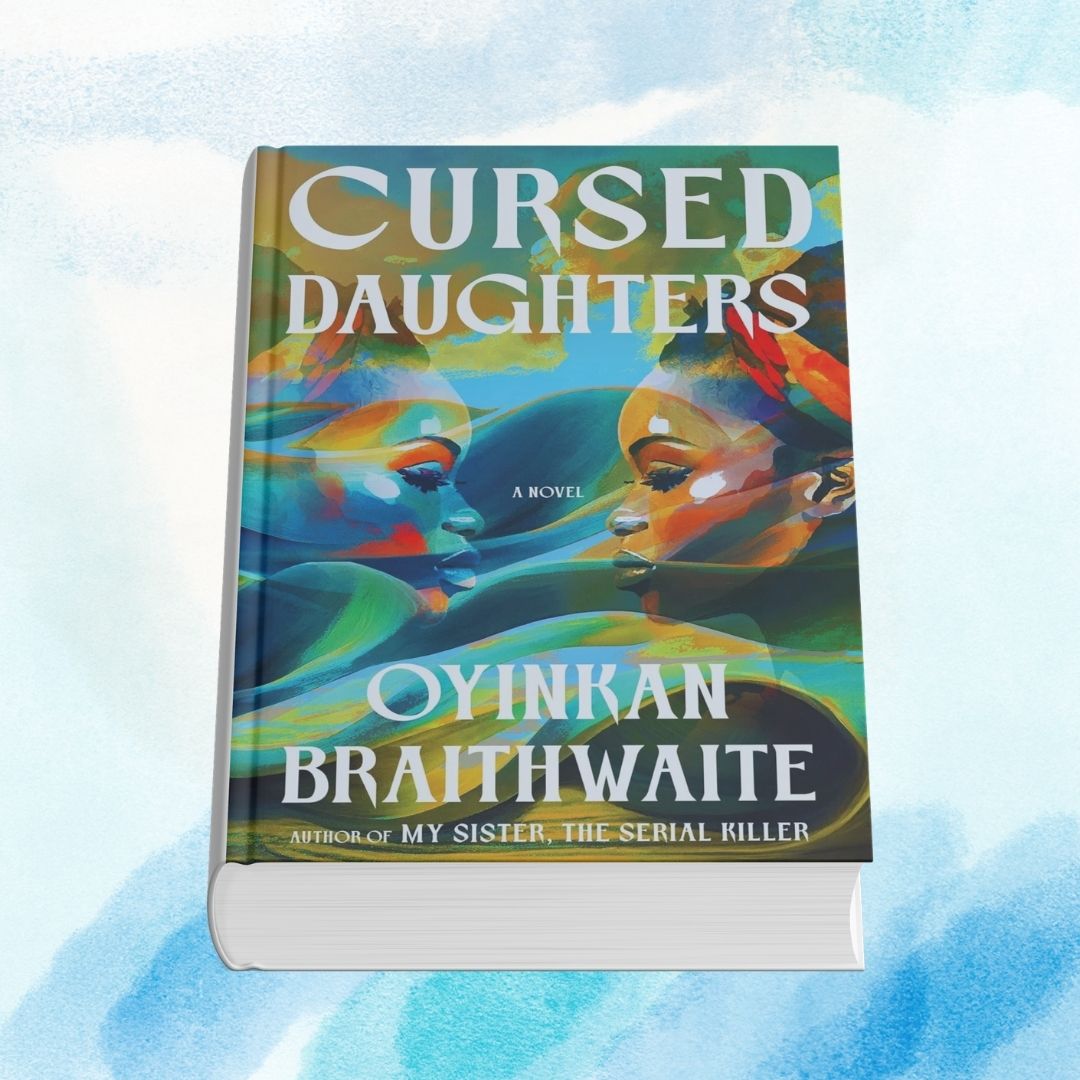
Cursed Daughters by Oyinkan Braithwaite
Genre: Literary Fiction | Published: 2025
It’s Women’s History Month, and the first review on the blog is Cursed Daughters, a story about a matriarchal family in Lagos, Nigeria, whose daughters are seemingly doomed to never find love or keep a man.
There’s so much about this novel that fits perfectly with the theme of the month. The story centres almost entirely on women and is driven by female characters at every level. It also speaks directly to societal expectations placed on women, and how a single “curse” — within a culture that places immense value on marriage and motherhood — can quietly derail the course of their lives.
There were two angles from which I wanted to approach this review. The first is the traditional book review: looking at the novel’s execution, from plot to pacing. The second is a more analytical lens, exploring the larger ideas behind the narrative — what the author may be trying to convey about gender, expectations, and trauma, and how successfully those ideas are conveyed within the story itself.
I would like to believe that Oyinkan Braithwaite had something deeper in mind when writing this book, particularly given the strong themes running beneath the surface. However, I did find that certain elements fell a little flat because of the novel’s pacing and execution.
It also raises an interesting question: when a story appears to critique or highlight a social system, is the author intentionally using metaphor to challenge it, or are they — perhaps unintentionally — still operating within that same framework? And am I unknowingly providing brevity that the author themselves never intended?
Synopsis
No man will call your house his home. And if they try, they will not have peace…
So goes the family curse, long handed down from generation to generation, ruining families and breaking hearts. And now it’s Eniiyi’s turn – who, due to her uncanny resemblance to her dead aunt, Monife, is already used to her family’s strange beliefs, as well as their insistence that she is a reincarnation. Still, when she falls in love with the handsome boy she saves from drowning, she can no longer run from her family’s history. Is she destined to live out the habitual story of love and heartbreak, or can she escape the family curse and the mysterious fate that befell her aunt?
Story Execution
I’ve always enjoyed the writing style of Oyinkan Braithwaite. As much as My Sister, the Serial Killer occasionally drove me up the wall, I appreciated its pacing, the sharpness of the prose, and the overall execution of the story.
With Cursed Daughters, I actually spent the first three-quarters of the book listening to the audiobook before switching to my ebook. I read much faster than I listen, and I wanted to absorb the details more carefully by reading it myself. Naturally, switching formats does affect how much you take in when it comes to writing style and prose.
That said, the writing and imagery are still masterful. Braithwaite paints a vivid portrait of Lagos and Nigerian culture, capturing both its beauty and its complexities. I particularly appreciated the insight into how families and religious communities respond to the idea of a “curse,” and the way traditional spirituality is often embraced when people are faced with the unknown. The novel offers a fascinating glimpse into how faith, tradition, and cultural beliefs intersect when people are searching for answers beyond the rational.
As an audiobook listener, I initially struggled with the structure of the novel, which moves back and forth between the past and present. However, I think this choice ultimately serves an important purpose. The shifting timeline reinforces the cyclical nature of trauma and how it is passed down through generations. By returning to the past, the novel highlights the importance of understanding the roots of family dynamics and conflicts, and how those unresolved histories continue to shape the present.
Where I struggled most with the book’s execution was the pacing. The novel begins quite slowly, immersing us deeply in the Falodun family. We spend a significant amount of time getting to know their dynamics, their struggles, and the complicated ways they exist around one another. I found this early section incredibly engaging. I especially enjoyed Monife’s storyline and the deeper exploration of how those earlier family dynamics influence Eniiyi’s experience in the present.
However, towards the end, the story accelerates very quickly—perhaps a little too quickly. It felt as though the careful groundwork laid in the earlier chapters was somewhat lost as the narrative rushed to wrap everything up. The ending, in particular, felt more melodramatic and plot-driven than I expected. The novel begins as a thoughtful, character-focused exploration of a deeply complicated family (whether we like them or not… and often we don’t), but by the final chapters, that careful character analysis and social commentary start to fade in favour of tying up the story.
Themes & Depth
There is so much to say on the themes being explored here and the role the ‘curse’ plays in the story as a literary device. The overarching question that Braithwaite is asking and somewhat trying to answer is whether it is truly a curse, or are the tragedies this family experiences simply the consequences of all the women in this family? The curse can be characterised as many things in this book, from the persistence of generational trauma to the societal expectations around marriage. And I would like to explore both here.
Generational Trauma & Inheritance
The novel speaks powerfully to the idea that the suffering of the Falodun women, while initially framed as a supernatural curse, is more plausibly the result of poor decisions, societal pressure, and the deep imprint of generational trauma. Over time, these forces become so embedded that they shape the women’s choices before they are even fully aware of them.
In many ways, the decisions the women make feel less like acts of free will and more like a quiet surrender to the curse itself. Through this, Oyinkan Braithwaite explores how generational trauma—particularly among women—can push people towards fulfilling the very prophecies laid out for them. When expectations are imposed strongly enough, they can box individuals in, making it far harder to imagine an alternative path, let alone fight their way out of it.
As a result, the women become increasingly defined by their pursuit of love and the validation of a man. They find themselves repeating the same patterns as the generations before them, almost inevitably retracing the same steps. At one point, as a male character within the family observes, the curse begins to take on a different meaning: it no longer feels like the women are cursed to be denied love, but rather cursed to obsess over it.
‘Twelve-year-old Ebun told sixteen-year-old Monife that she didn’t believe in curses. ‘That’s fine,’ said Monife, between the slow chewing of gum, ‘but what if the curse believes in you?’
Societal pressures
The role society plays in this cannot be understated. The “curse” can easily be read as a metaphor for the intense societal pressure placed on women to marry, and the sense of impending failure that awaits those who cannot fulfil that expectation.
Social forces play a significant role in sustaining the idea of the curse, raising the question of whether the curse is supernatural at all, or simply another form of social pressure. Expectations surrounding marriage, respectability, family reputation, and even tribal prejudice weigh heavily on the Falodun women. The constant emphasis on finding and keeping a husband only heightens the anxiety surrounding the supposed curse.
That familiar question — “When will you settle down?” — hangs over the family, shaping the relationships between the grandmothers, the mothers, and Eniiyi, the youngest woman in the family. Each generation carries the weight of those expectations, and every failed relationship becomes further “proof” that the curse is real. In reality, however, it is the pressure itself that is doing the damage, tightening around the women until love struggles to survive beneath the weight of it.
The fact that the worst thing that could have happened to this family is them being doomed to never have secure and long-lasting male companionship speaks to how patriarchy and male-centredness are rooted in our social practices. This brings me to my main critique of the book.
Critique
What happened to girlhood?
As mentioned, there is a strong emphasis on male-centredness throughout the novel and on the burden of partnership placed on women. This is where I began to question what Oyinkan Braithwaite is saying. Is she intentionally holding up a mirror to the ways society defines women through men, or does the narrative risk reinforcing that same mindset? I’m inclined to believe it is the former, but it becomes slightly difficult to hold onto that interpretation when almost every woman in the story is characterised primarily by the man — or the absence of one — in her life.
You could argue that the novel centres heavily on mother–daughter dynamics, and that’s true, but even those relationships are largely shaped by the curse and by the pressure surrounding men and marriage. Very few interactions between mothers and their daughters, or even between the cousins, exist outside of that framework. Their conversations and conflicts almost always circle back to romantic relationships and the anxiety surrounding them; the inability to find lasting love seems to become the defining measure of their lives.
Even Eniiyi, the youngest and arguably most progressive member of the family, appears to move towards a broader understanding of life beyond this obsession, yet she too struggles to escape the weight of those expectations.
I read a review that jokingly pointed out that no woman in the story ends up being a lesbian. While clearly said in jest — and the cultural context of the story absolutely matters — it does highlight an interesting point: none of the characters meaningfully seek fulfilment outside romantic relationships with MEN. We see very little of their inner lives beyond this pursuit. There are no female friendships( something we know holds so much value in any woman’s life), personal passions, and other forms of emotional fulfilment are largely absent from the narrative.
Because of this, I felt the novel missed an opportunity to explore womanhood, autonomy, and personal value beyond romantic relationships. The story gestures towards these ideas at times, but never fully commits to them. While it is possible that Braithwaite intended to show just how consuming these expectations can become, the point doesn’t always land as clearly as it could. At times, the narrative risks reducing its female characters to their relationships with men rather than fully exploring their individuality and agency.
Final Thoughts
Overall, I really enjoyed this book. From a narrative and plot perspective, I rated it fairly highly — the premise alone is incredibly compelling. What I ended up enjoying even more, though, was exploring the story through a more analytical lens while writing this review. The novel speaks to so many larger ideas about women, family, and society: how learned behaviour persists across generations, how trauma is inherited, and how difficult it can be to break those cycles.
Writing this review allowed me to engage with those themes in a much deeper way than I did when I was simply reading for enjoyment. Initially, when I finished Cursed Daughters, I gave it four stars. That said, while reflecting on the book, I did briefly lower my rating to around 3.75 stars, mainly because the pacing in the final quarter pulled me out of the narrative somewhat. However, it’s been a while since a book has made me think so deliberately about literary devices and thematic symbolism. The idea of the “curse” works as such a powerful metaphor that, in the end, it ultimately elevated the reading experience for me.
For that reason, I’ve settled back on,
I thoroughly enjoyed writing this review, and I hope you enjoyed reading it as much as I enjoyed putting it together. I’d love to hear from anyone else who has read the book and discuss your thoughts on it.
Signed,