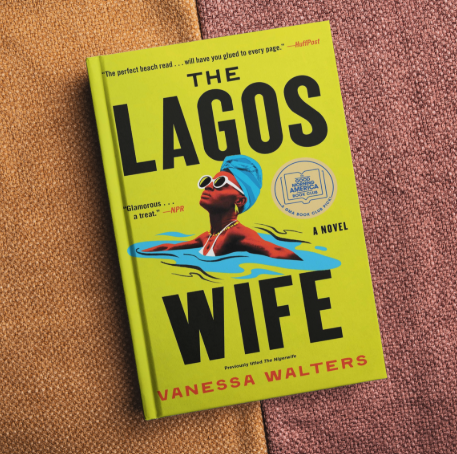
The Lagos Wife by Vanessa Walters
Genre: Thriller | Published: 2023
This was the April pick for my book club, which I was glad about, as it had been on my radar for months. What I had hoped would be an intense thriller in the vein of My Sister, the Serial Killer (as described) instead turned out to be a melodramatic family drama with a flat plotline, unlikable characters, non‑fiction‑like narration, and a borderline disturbing undertone that left me deeply uncomfortable.
I felt a range of emotions while reading this book. At times, I was genuinely interested and could even find moments of engagement in the story, and at others, I felt completely detached. Vanessa Walters clearly attempts to write an engaging, socially astute novel that explores the very real, lived experiences of non-Nigerian women who marry Nigerian men and begin their lives in Nigeria — often without family, hoping to find a sense of community. She capitalises on the very real and unsettling premise of what happens when a woman with no familial support becomes stranded in a country where she has very few options. It is, in many ways, a very promising premise.
Unfortunately, it delivers very little.
Synopsis
Formerly titled ‘The Niger Wife’, The Lagos Wife follows a woman who travels to Nigeria to uncover what happened to her missing estranged niece.
Nicole Oruwari has the perfect husband, a palatial house in the heart of Lagos, and a glamorous group of friends. She left gloomy London and a troubled family past behind for sunny Lagos, becoming part of the Nigerwives—a community of foreign women married to Nigerian men.
But when Nicole disappears without a trace after a boat trip, the cracks in her alleged perfect life start to show. As the investigation turns up nothing but dead ends, her auntie Claudine decides to take matters into her own hands. Armed with only a cell phone and a plane ticket to Nigeria, she digs into her niece’s life and uncovers a hidden side filled with dark secrets, isolation, and even violence. But the more she discovers about Nicole, the more Claudine’s own buried history threatens to come to light.
Themes & Focus
The Lagos Wife aims to touch on a number of really interesting and strong themes that should all blend very seamlessly into one narrative. Nigeria is an extremely classist and patriarchal society that often treats women as second-class citizens. Nicole, in this story, is a foreign light-skinned woman with light eyes, a commodity in an extremely colourist society, yet this privilege does not shield her from the very real lived experiences of many Nigerian women. Her familial isolation (though by choice) means she must seek out her own community in a land that would otherwise ostracise her, despite also somewhat placing her on a pedestal. We are shown what women are often expected to endure and conceal at the expense of keeping the peace and staying married (the ultimate prize). She is controlled in her marriage and given little agency to live a full and realised life. She is robbed of her ability to mother her children in a society that leaves child rearing to the lower class, and her life is defined by faux respectability, a showcase of wealth and ostentatiousness, while consistently being deprived of true peace and joy. Which she eventually seeks out by any means necessary.
There is so much about this story that speaks to the lived experiences of so many women across all societies, not just in a country like Nigeria, and I would even go as far as to say that there is so much to take away from this. Unfortunately, when it comes to these aspects, the book reads like a character study rather than a fully realised character in a book. I say very often that when stories touch on social commentary, it’s never done in a subtle way but in a beat you over the head kind of way, and the characters stop feeling like real people but become mouthpieces for the author to tell us how they feel on a subject. This happens numerous times in the story.
Writing Style
I can’t say I was particularly drawn in by the writing style. The prose is very matter‑of‑fact — there’s no rhythm or flow. The writing is extremely inconsistent, alternating between what could pass as a clear narrative with some structure and what ultimately feels like words scattered on a page. I switched between the audiobook and the ebook largely because the ebook wasn’t gripping me at all, and listening was the only way I could get through the book.
Considering this book is marketed as a thriller, there is almost no tension built into the prose. We’re never on the edge of our seats, we aren’t biting our nails, and quite frankly, we’re not particularly bothered by the fact that Nicole is missing. A severe lack of suspense and atmosphere in a setting that almost guarantees such.
The book reads more like a family drama than a thriller. Given that it’s described as a thriller, this definitely counts as a mark against it. That said, there is nothing inherently wrong with a family drama. It could have been a stark and compelling exploration of Nigerian family dynamics — the role of the father as the head of the family, the pressure on everyone to conform, and the emotional fallout of that rigidity. However, the prose simply isn’t strong enough to deliver on this either. Again, there is nothing wrong with clear and simple prose in principle, but here it just doesn’t do the work it needs to do.
Additionally, the pacing is all over the place. It takes a good 50% of the book for the story to really kick in. The novel feels bogged down by scenes that reveal very little about the characters; they lack sufficient depth in both description and development. Everyone feels rather surface‑level, particularly Nicole and her husband. Claudine — who we are clearly meant to be intrigued by, with secrets of her own, never fully delivers, and even her story, which ends up with its own twists and turns, never hits as hard as they are clearly meant to. In the moments where we do connect with her and validate her frustration and suspicion of the family, that momentum is immediately lost in the following chapter, where we return to Nicole and her shallow entanglements.
The final third of the book suddenly shifts pace, and what should be an exciting rush towards the climax instead becomes an extremely hurried ending. The twist isn’t particularly worthwhile, and the conclusion itself leaves a great deal to be desired.
What Really Bothered Me
I am a Nigerian woman, born and raised in Nigeria. I go back regularly and have seen Nigeria in all its realities, from the fast life that’s portrayed every December to the very real, everyday struggles visible on the streets. I am in no way disillusioned about the reality of my country: the hardships people face, the deeply ingrained misogyny that runs rampant, the colonial mindset present in everyday life, and the way classism wreaks havoc on the poor and keeps them stagnant. All of these realities are portrayed in the book.
However, the fact that this story is written from the perspective of two women who are not Nigerian leaves a bad taste in my mouth. Now, this is not to say that non-Nigerians are not allowed to criticise Nigeria, but often the tone begins to cross into territory that feels supremacist in nature. These two British Jamaican women, while seeing and experiencing aspects of the culture, still feed into harmful narratives while somehow being heavily critical of it. Now, one could say this is a device to show how a society can suck you in even when you don’t intend it to, but I don’t think that’s what is happening here. The tone in which Nigeria is described is, at times, deeply disturbing. Not only is Nigeria painted as simply a corrupt and vile nation, but almost every Nigerian in the book is brushed with the same stroke, reduced to a monolith; there is no balance. I question whether this was a deliberate narrative choice, but considering the author herself is British Jamaican, I can’t help but feel that these are her own thoughts and feelings seeping into the narrative. Given that she is a woman married to a Nigerian and has Nigerian children, it also makes me question how she truly sees Nigerians.
Additionally, much of Nigeria is described as though we are reading a secondary school history textbook, with facts and information rabbit‑holed into random chapters as if to give the reader a history lesson. These details never feel well-placed or organically woven into the story.
There is also the matter of how the history of the slave trade — and the role Nigerian tribes played in it — is handled. Much of the history presented parrots divisive notions about who sold whom. I’m not here to give a history lesson myself, as that would take far too long to unpack, but these moments are delivered with a distinctly accusatory and divisive tone. This notion continues in what ends up being Nicole’s ultimate ‘demise’, Nigerians vs its Non Nigerian victims. Once again, it makes you question whether this is a narrative choice or the author’s own voice bleeding into the text.
At times, this was a very difficult read, and that only exacerbated the sense of disconnect I felt throughout the book. I can’t say that every reader would feel the same way, but I also wouldn’t be surprised if other Nigerians shared this reaction.
Final Thoughts
This ended up being a far more negative review than I intended, but it was a feeling I simply couldn’t shrug off. A strong premise with so much potential was ultimately undermined by an unfortunate execution that left a bad taste in my mouth.
That said, I would still recommend the book, if only because I’m curious to hear how other people felt about it and how they interpreted its themes.
I hope you enjoyed this review, and I would love to hear your thoughts!
Signed,